to add: the intention framework (and clean up a paragraph below too)
Intention is the primary tool of the spiritual arts. It is the point where awareness gathers into coherence. It is not effort, force, or willpower. It is the quiet alignment that directs energy, perception, and action into unified movement. Like a wand or a brush, intention shapes what is being formed. It guides healing, dream work, intuitive sensing, psychic perception, manifestation, and other subtle practices by giving direction to awareness itself. Without clear intention, energy scatters. With intention, the inner field organizes.
the tool of intention
It is clear and unblocked intention that allows us to create. In dreams, if we wish to change something, we state clearly what we desire. In daily life, if we wish to only feel our own energy, we can state “this is not mine” or “only mine.” In psychic work, if we wish to explore a certain area of someone’s life, we simply ask. We do this in the mind’s eye and allow ourselves to open to what feelings and emotional tone guide and direct us. These emotional energies can also be used to strengthen intention.
However, sitting in the power of intention takes time to develop. It becomes more complex depending on the discipline or task. Asking not to take on external energy on a bus is simpler than sorting through someone’s memory in a mediumistic way. Not everything is always accessible. When working with intention, you are working with conscious intelligence both within yourself and collectively, and what is accessed must resonate and match in frequency.
In this sense, intention must move in alignment with the universal movement toward coherence, balance, and integration. Some work (light work) supports this through repair, healing, and restoration. Other work (dark work) supports it through clearing, boundary holding, exposure, and necessary endings. Both serve the same field of intelligence. What matters is whether the work restores coherence and truth, or whether it distorts and fragments. When intention aligns with coherence, it moves in flow with the deeper intelligence of the universe.
To truly sit in the power of the spiritual arts, the right side of the brain opens into flow while the rational stream steps aside. Development often moves in two directions at once. There is structure, discipline, logic, and learning, and then there is the step back where what has been learned is released so intuition, flow, and the subconscious can move freely. The ego steps aside. This is true across many art forms and is the doorway into real flow states, where the deeper intelligence that never forgets is allowed to lead.
and once you get the hang of working with the tool of intention, it can more easily be applied to different art forms.
The Spiritual Arts explained
The spiritual arts function much like martial arts. They are fully embodied, disciplined practices that develop through training, repetition, and refinement, while also allowing flow states and awakenings to surface when the body and awareness are ready. In fact, one may consider martial arts a spiritual art due to its lineage and links to mindfulness, meditation, and spiritually based philosophies, as well as its connection to nature, symbolic language, metaphors, and imaginative stances.
Across all spiritual disciplines, the underlying premises are often the same. They leverage intuitive senses and shared languages of consciousness. What differs is how these capacities are applied, where they are directed, and what form the output takes. Much has already been studied and explored, yet like any true art form, expansion remains open ended. Development is limited only by what we believe is possible. A true artist eventually releases what is already known, allowing inspiration to guide the work into new territory. In this way, spiritual practice enters flow states and becomes an art in the same way as painting, music, and movement are art.
In fact, spiritual arts often incorporate other art forms to deepen development and expand expression. Writing, drawing, chanting, movement, sound, and symbol work are commonly used to support integration, perception, and creative output, allowing awareness to move through multiple channels rather than remaining only in thought. A loop forms where Spiritual art creates inspiration for materialized art forms, and materialized art forms creates inspiration for spirtual art.
to add:
- lanaguage in the spirtual arts have been defined over the course of time, many different type of schools of thought in different cultures, religions, professional institutuons, scentific discoveries, etc. it is helpful to have this common language to collaborate dicuss and explore as a group, socierty, social creations for expansions. however, the spirtual arts domain is truly infinte, and there is also a call to choose what you want to on-board and believe. if you want to see the energy center in your head, having a purple colour, if you want it to represent you pitutiary gland, or third eye, or something comepltly diferent, it is your playground. what ever reaonsates is true, weither it comes from you or from an infulence (known or unknown). schools of though and teaching are super helpful along the way, but there are many paths, it is fun to explore them and take form them what alignes and makes sense to you.
- there hve been times where i thought i made some great discoveries only to find out someone else already dpocumented it, maybe recently or maybe thousands of years ago. at the same time, it is inifitie like a canvas is inifitie, but there is still the univerises experience, and there are set paramaters, characteritics, experiences etc. that are common. it is like we are all automobiles, all differen,t can go in many different places, but we have the same functions, lights on/off buttons, mechanical diagnosis indicators, etc. etc.
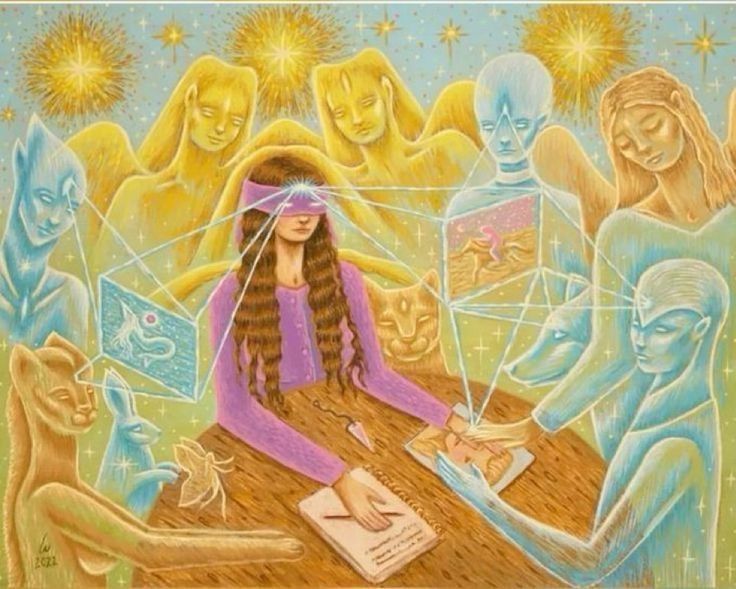
life effects from spirtual art development
- Ability to use intention for creating change and positive outcomes in your life (example – manifesting, intuitive readings, synchronicity awareness), Greater emotional steadiness
- Clearer decision-making, self-trust and confidence
- Stronger internal boundaries
- More presence and calm in daily life
- A clearer sense of what is and is not yours to carry
- More internal space for creativity
- A pathway to help others, inspiration, healing, etc. Improved sleep and dream clarity
- Easier access to flow, timing, and opportunity
- Greater coherence and natural confidence
Examples of spiritual arts and practices
• Dream work
• Manifestation
• Intuitive development
• Psychic sensing
• Energy healing
• Mediumship
• Shamanic practices
• Somatic healing
• Breath work
• Symbol and archetypal work
• Plant medicine traditions
• Visioning and inner journeying
• Astral exploration
• Meditative and mindful arts
• Ritual work
• Spirtual and intentional movement practices
• Martial arts as spiritual practice
• Prayer and contemplative practices
• Oracle and divination work
• Body-based awareness arts
• Elemental and nature-based practices
• Ancestral and lineage healing
• Subconscious reprogramming
• Creative channeling
• Writing as spiritual art
• Drawing and visual channeling
• crystal workers
• birth and death doulas
 Default Mode
Leave a comment